
Sex Offender Checks in San Jacinto County
The Texas Public Sex Offender Registry is the first stop for a San Jacinto County sex offender check. Texas DPS manages the statewide data. Search by a registrant's name or narrow the geographic fields to an address, city, ZIP code, or San Jacinto County. The registry also includes a higher-education search. It is free and reflects the public portion of reports sent by local registration authorities.
Local responsibility depends on where a person lives. A police chief generally registers an address inside a municipality. The sheriff handles an address outside municipal limits. Shepherd has an established police department, while official material for Coldspring and Point Blank does not publish a city police records desk. For either of those cities, call the San Jacinto County Sheriff and confirm which authority holds the registration. The county does not publish a second local registry that replaces the Texas DPS search.
The official San Jacinto County registry interface shows the neutral search screen and its geographic options.
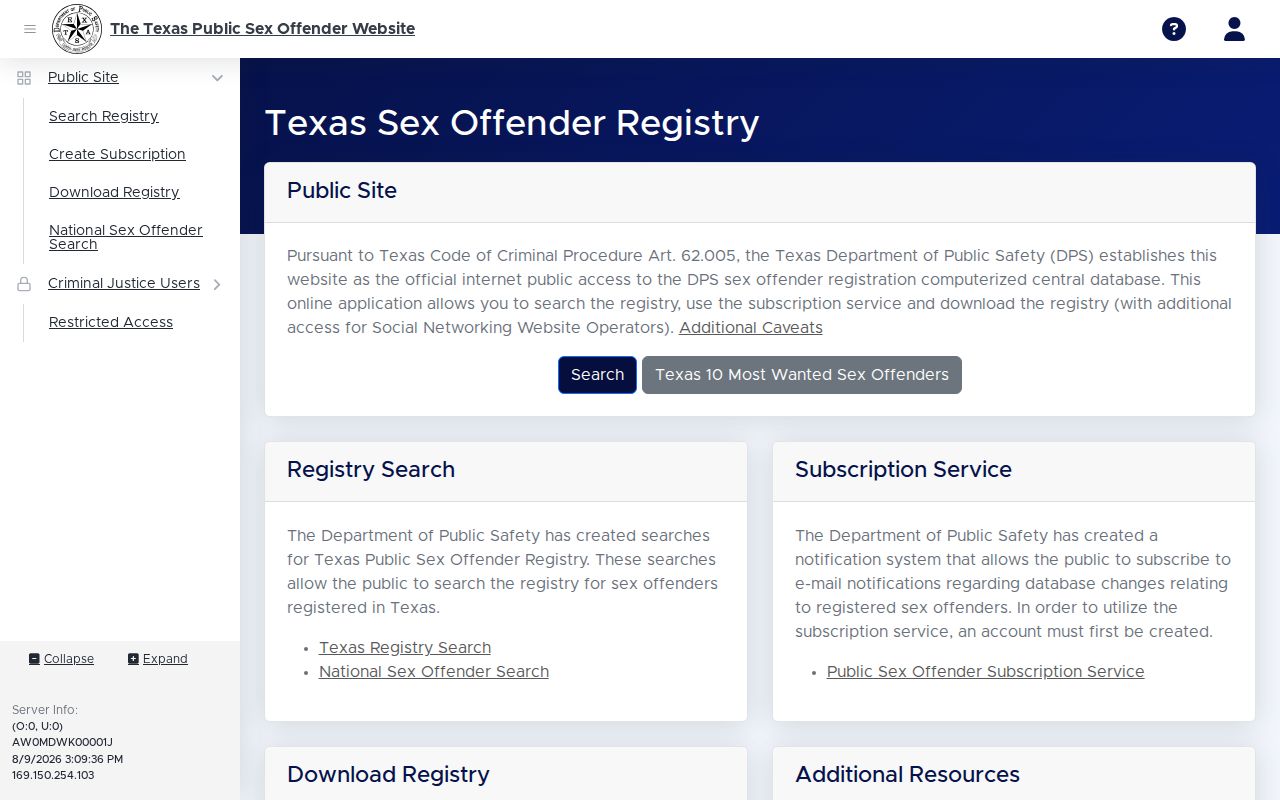
That interface is the common entry point whether the address falls in Shepherd or a rural part of San Jacinto County.
How to Search the Texas Public Sex Offender Registry
Use the strongest location or identity detail available. A name search can miss spelling changes or return several people, while a geographic search can reveal registrants near a known place. Read the result page rather than drawing a conclusion from the list alone.
- Open the Texas DPS public registry and review its conditions of use.
- Enter a name, or choose Address, City, ZIP Code, or County as the geographic path.
- Select San Jacinto County when using the county filter, then compare aliases, birth date, photo, and physical details.
- Open the full public profile and confirm the address, offense record, risk level, and registration or verification status.
| Field Label | Type | Required or Use | Notes |
|---|---|---|---|
| Name | Text | Use for a person search | Spelling matters; compare aliases and identifiers |
| Address | Text / geographic | Use for proximity work | Enter the location to see nearby results |
| City | Text / dropdown | Optional limiter | Useful for Shepherd, Coldspring, or Point Blank |
| ZIP Code | Text | Optional limiter | Broadens the check beyond city limits |
| County | Dropdown | Optional limiter | Select San Jacinto County |
| Institution of Higher Education | Search choice | Separate search | Used for campus-affiliation records |
Note: A search result is a public registry entry, not proof that every nonpublic registration field is shown or current to the minute.
San Jacinto County Offender Risk Labels
Texas assigns risk levels 1, 2, and 3 under Article 62.007 of the Code of Criminal Procedure. Level 1 is low, Level 2 is moderate, and Level 3 is high. These labels reflect a state risk assessment. They are not the federal SORNA tier system, and the number alone does not decide how long a person registers.
Registration length turns mainly on the reportable offense and the rules in Article 62.101. This difference matters when reading a San Jacinto County sex offender profile. A Level 1 label does not automatically mean a short period, and a higher level is not a stand-alone statement of the sentence or current conduct. Look at the offense, disposition, registration status, and verification entry together. When a profile seems inconsistent, ask the local registration authority or DPS to verify it.
Inside a Registry Profile
A public Texas registry profile joins identification, location, offense, and compliance information. It deliberately omits protected data. Those limits protect victims and prevent the public interface from exposing identifiers used only by law enforcement.
| Name and Aliases | Full public name and reported aliases used to distinguish the registrant. |
|---|---|
| Photo and Description | Recent public photo plus sex, race, height, weight, hair, and eye details. |
| Registered Address | Primary and other public addresses reported for registration purposes. |
| Offense Record | Qualifying offense, statute, date, court, and disposition information. |
| Risk Level | Texas Level 1, 2, or 3 assessment where reported. |
| Registration Status | Registration and verification indicators, including a public status concern when shown. |
| Other Public Fields | Higher-education indicator and qualifying trafficking-offense vehicle data when applicable. |
| Not Public | SSN, driver license number, phone, online identifiers, employer contacts, and victim-identifying details. |
Texas DPS provides official program guidance that explains why the public profile is only part of the registration record.
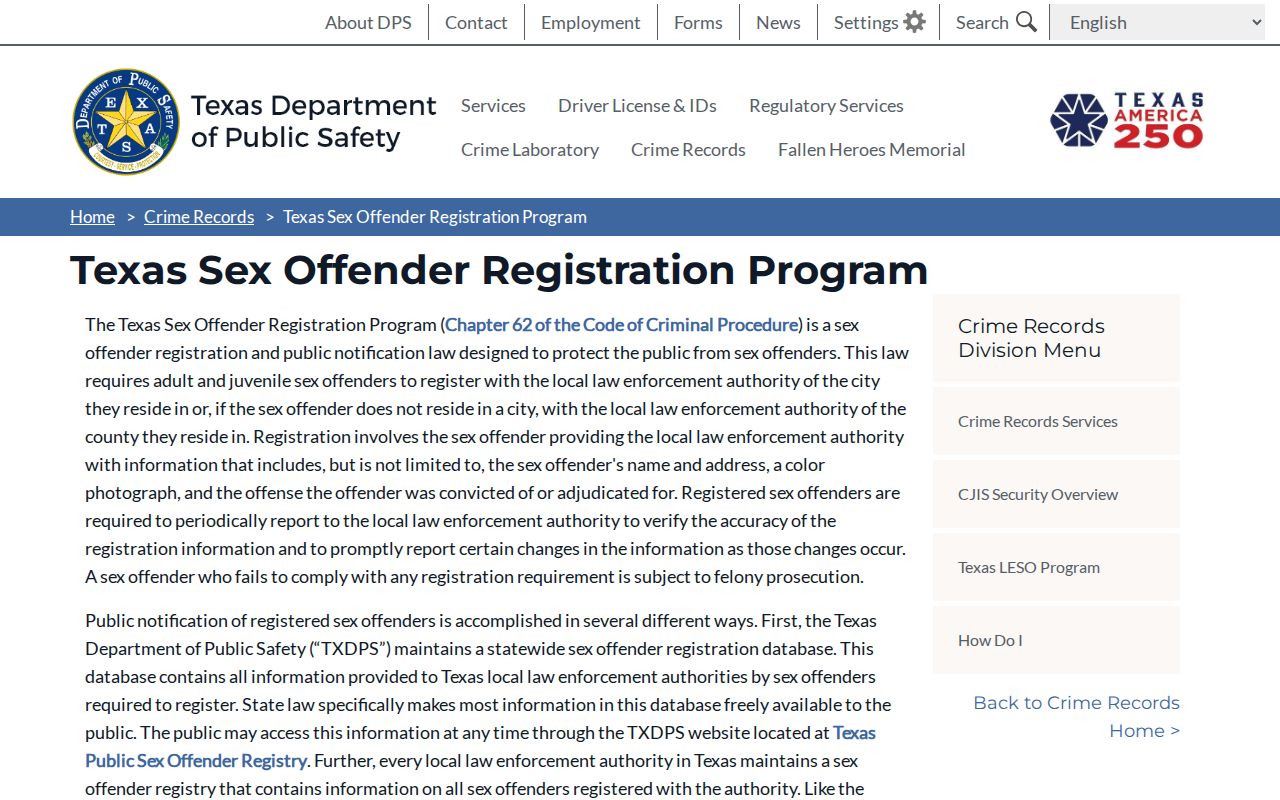
The program guidance gives the profile fields their legal context and helps avoid overreading a single status label.
San Jacinto County NSOPW Search
Use the National Sex Offender Public Website when a name or address trail crosses Texas lines. NSOPW draws public information from participating state, territorial, and tribal registries. It is a cross-state layer, not a replacement for the Texas profile or a San Jacinto County registration contact.
A practical check starts with NSOPW for broad reach, then returns to the source registry linked in the result. Read the Texas entry for state-specific risk terms, offense details, and local status. If a person recently moved, also search the old place and the new one because update timing can differ. A no-result should prompt a spelling check and a wider location search. It should not be treated as a guarantee about conduct or identity.
The official NSOPW search page illustrates the national layer available to San Jacinto County residents.
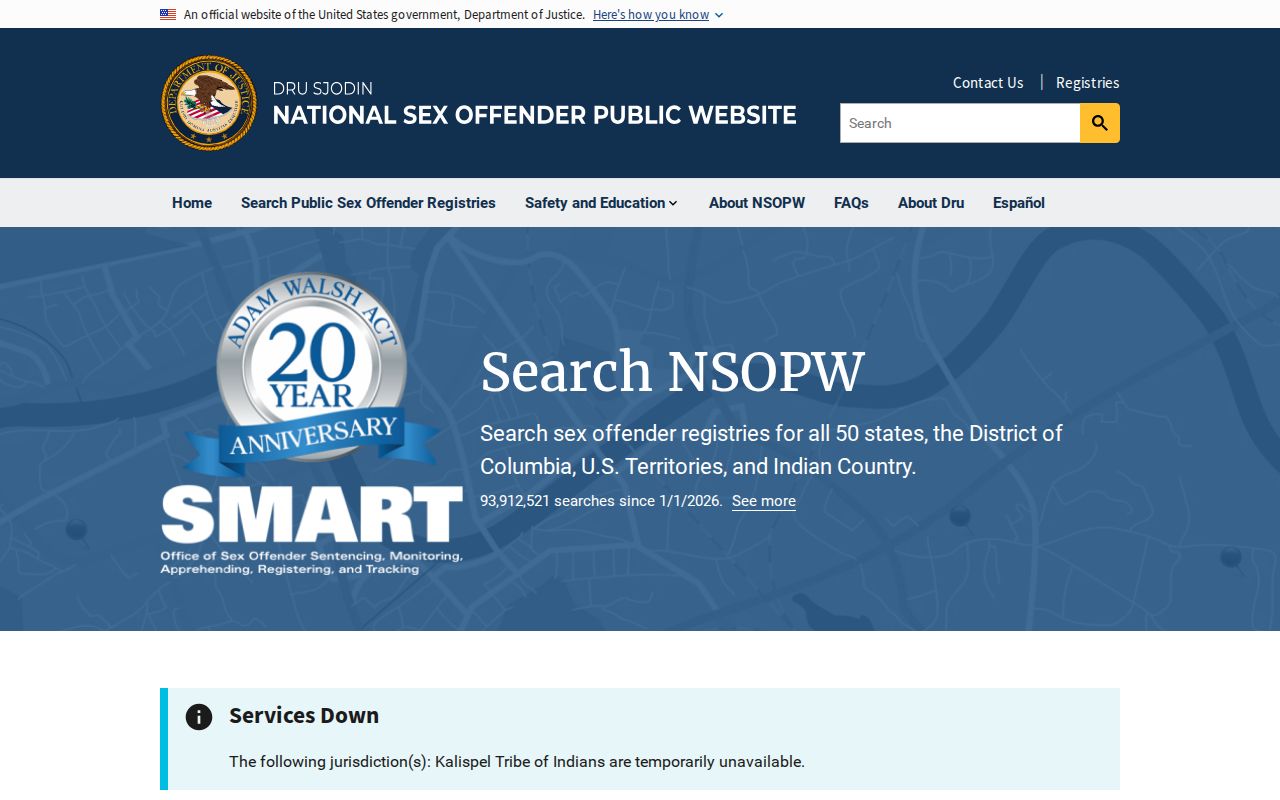
Following its result back to the source registry preserves the local and state meaning of each field.
Texas Registration Levels and Requirements
Risk and duration answer different questions. Article 62.101 makes duration offense-based. Verification can be annual, every 90 days, or every 30 days for certain categories. The table states general Texas rules, so the registering authority should confirm a specific duty.
| Category | General Duration | General Verification |
|---|---|---|
| Listed sexually violent or specified adult offense | Lifetime | Generally annual |
| Other adult reportable offense | Generally 10 years after the latest discharge, release, or supervision completion | As directed under Chapter 62 |
| Juvenile adjudication | Generally 10 years from disposition or completion, whichever is later | As directed; some juvenile registration may be nonpublic |
| Two or more sexually violent convictions | Lifetime | Every 90 days |
| Civilly committed sexually violent predator | Lifetime category | Every 30 days |
The governing Texas Code of Criminal Procedure Chapter 62 supplies the rules behind San Jacinto County registration duties.
The statute confirms why a simple risk number cannot be used as a shortcut for duration or reporting frequency.
San Jacinto County Registry Notifications
Community notice takes more than one form. Texas DPS sends English and Spanish postcards around a high-risk registrant or civilly committed sexually violent predator who moves into a community. Local authorities also handle required school notice. These notices focus attention on a verified move and should be read with the current public profile.
The Texas DPS mobile app advertises map, route, and proximity functions. Those tools can help a San Jacinto County resident check places along a route rather than only one fixed address. They do not create a new local list, change the public fields, or certify that a route is risk-free. Refresh searches over time, since addresses and registration statuses can change. For the broader records landscape, the San Jacinto County criminal history overview explains why registry, court, and booking records answer different questions.
San Jacinto County Registry Distance Rules
Texas Chapter 62 does not create one statewide residency-distance rule that can be quoted for every San Jacinto County address. Local restrictions, supervision terms, and rules tied to a particular legal status can differ. A map pin near a school, park, or day-care site therefore does not prove a violation by itself.
Ask the correct authority about a specific restriction. The police chief is the usual registration authority inside a municipality, while the sheriff serves areas outside one. A probation or parole condition may come from a court or supervision agency rather than the public registry. Keep the question narrow: identify the address, the rule believed to apply, and the agency that issued it. This approach avoids spreading an invented countywide distance rule and lets the office with the underlying record make the compliance judgment.
Correcting San Jacinto County Registry Details
Stale or missing public information should go to the registering authority or Texas DPS. Record the profile name, public address, status field, and the detail that appears wrong. Do not seek protected identifiers. If the question concerns a rural address, the San Jacinto County Sheriff is the logical first call. For a municipal address, confirm whether the police chief or sheriff holds the registration.
Suspected noncompliance should be reported, not investigated by a neighbor. Give the local authority clear facts and let trained staff compare them with the full registration file. DPS can address statewide portal questions. Emergencies still belong with 911. This channel keeps the focus on accurate public information and avoids contact that could escalate into harassment.
Note: Registry data changes; verify a San Jacinto County profile with the registering authority before relying on an address or status.
Community Notification and Lawful Use
The registry exists for awareness and safety planning. Use it to understand a neighborhood, prepare a family safety talk, or confirm what the state has made public. Compare identity fields carefully. Similar names, older photos, and address changes can lead to a wrong conclusion. The state profile and local authority are the sources to verify.
Public access does not authorize threats, injury, intimidation, or vigilantism. Nor does a registry profile invite a searcher to expose protected family or victim information. Chapter 62 controls the registration system, and other criminal laws still apply to conduct directed at a registrant or household.
Use registry information lawfully: Texas DPS warns that registry information must not be used to injure, harass, or commit a crime. Misuse can itself result in criminal penalties under Texas Code of Criminal Procedure Chapter 62 and other Texas law.